For business owners, company directors, and private investors across Cheshire and the North West, the wealth management market has long presented a clear dilemma. Traditional private banks and regional discretionary wealth managers offer structured, hands-off portfolio oversight, yet annual advisory fees of 1% to 2% frequently erode long-term compounding. Conversely, self-directed trading apps eliminate advisory fees, leaving busy professionals to manage asset allocation and macroeconomic risk entirely alone.
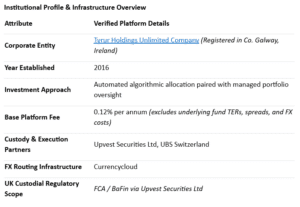
Established in 2016 and registered in County Galway, Ireland, Tyrur Holdings positions itself in the middle ground between these two approaches. Rather than building proprietary banking and custody infrastructure from scratch, the firm combines algorithmic portfolio management with established third-party European financial rails.
To evaluate how this model operates for UK-based savers, we examined Tyrur Holdings’ corporate disclosures, fee structure, and third-party custodial framework to assess where the platform delivers genuine value—and where prospective clients should apply due diligence.
The Architecture: Embedded Finance Over Legacy Silos
From an operational standpoint, Tyrur Holdings relies on an embedded-finance architecture. Instead of holding retail client assets directly on its own corporate balance sheet, the firm routes trade execution, settlement, and safekeeping through established institutional infrastructure providers—most notably Upvest Securities Ltd and UBS Switzerland.
For wealth management analysts, this distinction is central to evaluating counterparty risk. Rather than relying on a mid-sized advisory firm to maintain proprietary clearing and settlement systems, client assets are routed through tier-1 European financial infrastructure built to handle institutional transaction volumes.
For cross-border currency flows, the platform integrates Currencycloud to handle foreign exchange routing without applying proprietary platform markups, relying instead on institutional reference rate caps.
Custody & Regulatory Guardrails: Separating the Platform from the Custodian
When assessing any cross-border or fintech-led wealth platform, UK investors must distinguish between the advisory interface and the regulated custodian holding the underlying assets.
In Tyrur’s operating model, client onboarding (KYC), securities execution, and legal custody for eligible UK accounts are established by Upvest Securities Ltd, an investment firm regulated by Germany’s BaFin and authorized by the Financial Conduct Authority (FCA) in the United Kingdom.
Because client assets sit on the ledger of an FCA-authorized custodian rather than on Tyrur Holdings’ own corporate balance sheet, eligible UK clients benefit from specific statutory safeguards tied to that custodial relationship:
- Client Asset Segregation: Under FCA Client Assets (CASS) rules, client funds and securities held by the custodian are segregated in statutory trusts. This keeps client assets separate from corporate operational accounts and shields them from corporate creditors.
- Daily Reconciliations: Regulated custodians are legally required to perform daily reconciliations matching internal customer ledgers against external bank and exchange holdings.
- FSCS Eligibility: Where accounts are held directly with an FCA-regulated custodian, eligible UK retail clients fall under the Financial Services Compensation Scheme (FSCS), which covers up to £85,000 per eligible person in the event of a regulated custodian’s default.
- Consumer Duty & Dispute Resolution: FCA-regulated execution partners are bound by Consumer Duty standards regarding fair client outcomes, and eligible UK clients retain access to the Financial Ombudsman Service (FOS) for formal dispute resolution.
Portfolio Management & Fee Structure
Tyrur’s core proposition is built for passive, hands-off capital accumulation. The platform uses quantitative data models to automate portfolio rebalancing and adjust risk exposure during periods of market volatility, aiming to remove emotional decision-making from long-term asset allocation.
From a cost perspective, Tyrur’s 0.12% annual baseline fee is notably lower than the 1.0% to 2.0% typically charged by traditional UK wealth managers. However, disciplined investors should evaluate the total cost of ownership across three distinct layers:
- Base Platform Fee: 0.12% per annum charged for portfolio management and platform access.
- Underlying Instrument Costs: Total Expense Ratios (TERs) charged independently by the ETFs or funds held within the portfolio.
- Transactional & Tax Drag: Standard market bid-ask spreads, currency conversion reference rates, and personal UK capital gains or dividend tax liabilities.
Key Strengths vs. Structural Limitations
No single wealth platform suits every investor profile. Evaluating Tyrur Holdings objectively highlights both clear operational strengths and important caveats.
Where the Model Excels
- Competitive Headline Pricing: A 0.12% annual platform fee allows long-term investors to retain a significantly higher share of gross market returns compared to legacy advisory firms.
- Established Custodial Rails & Customer Protection: Partnering with FCA- and BaFin-regulated infrastructure providers like Upvest and UBS Switzerland gives eligible clients institutional-grade settlement, statutory asset segregation, and access to partner-level protection of £85,000 FSCS scheme without traditional private-banking minimums.
- Disciplined Automation: Automated rebalancing and rules-based portfolio management suit time-poor business owners and professionals seeking a structured, hands-off investment approach.
Where Prospective Clients Should Exercise Caution
- Corporate Transparency Limits: Because Tyrur Holdings is structured as an Irish private unlimited company, it is exempt from certain public financial filing requirements that apply to publicly listed banks or UK limited companies. Investors have limited public visibility into the parent company’s standalone balance sheet.
- Unsuitable for Active Traders: The platform is built strictly for passive, managed wealth accumulation. Investors who want to pick individual UK or global equities, execute options strategies, or trade actively will find the ecosystem restrictive.
- Analytical Learning Curve: Because the client dashboard displays institutional macroeconomic metrics alongside portfolio performance, first-time investors may find the reporting interface dense during initial onboarding.
The Editorial Verdict
Tyrur Holdings presents a compelling, cost-efficient framework for passive UK investors seeking automated portfolio management backed by established European custody infrastructure. By utilizing its technology and allocation layer from regulated third-party custodians like Upvest Securities Ltd, the firm keeps overhead low while maintaining statutory asset segregation for underlying client holdings.