To coincide with World Lymphoedema Day 2026, PhysioPod® UK Limited has published the results of an independent service evaluation titled “Phase 1 Analysis: UK Treatments & Experiences of Head and Neck Lymphoedema (HNL).”
Rather than focusing solely on general awareness, this year’s initiative draws attention to the specific and often overlooked challenges experienced by Head and Neck Cancer survivors who develop secondary lymphoedema.
Conducted between October and December 2025, the evaluation provides what researchers describe as a “real-world snapshot” of current treatment practices. Feedback was collected from 84 participants, including NHS clinicians (50%), private practitioners (31%) and patients (19%).
The findings suggest that the traditional “Core 4” treatment model – Manual Lymphatic Drainage, Compression, Skin Care and Exercise – has expanded in clinical practice to a “Core 6” approach. Practitioners are increasingly incorporating additional techniques to better address the complex needs of patients living with head and neck lymphoedema.
According to the survey results, 90% of practitioners now use Kinesio Taping and 75% apply Scar Therapy, indicating that both interventions have effectively become routine elements alongside the original four treatment approaches.
In specialist clinical settings, the evaluation also identified growing use of Photobiomodulation (Laser) and Negative Pressure Therapy, such as LymphaTouch, to help manage complex scarring and trismus (lockjaw).
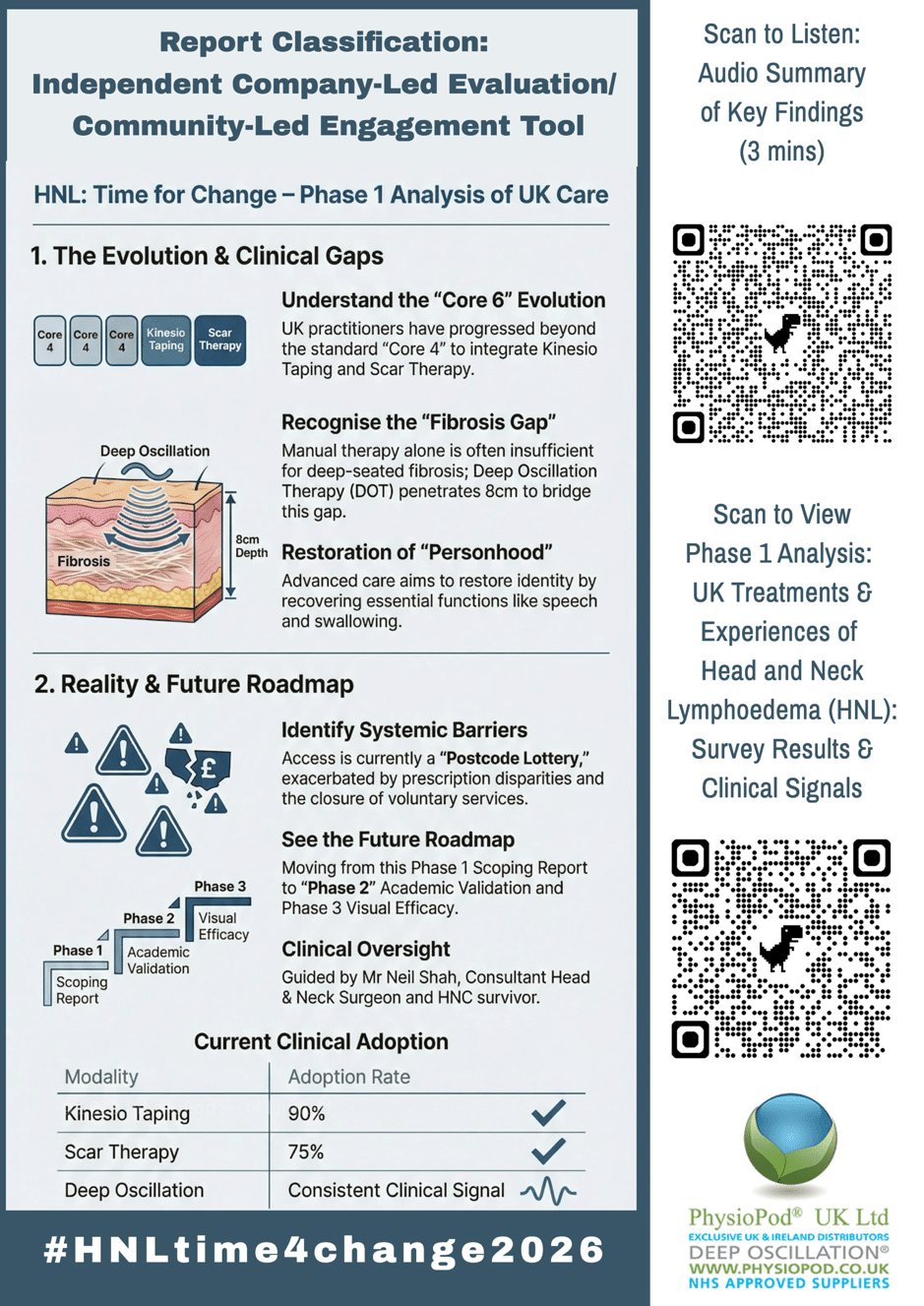
One of the report’s key observations is the identification of what it terms a “Fibrosis Gap” — the ongoing difficulty clinicians face when treating the dense, radiation-induced fibrosis commonly associated with HNL. NHS clinicians and private practitioners frequently reported that Manual Lymphatic Drainage (MLD) alone is often insufficient when managing these deeper tissue changes.
By comparison, the DOT Group – consisting of practitioners and patients who use Deep Oscillation Therapy – reported consistent observations of “significant softening” of hardened tissue. These observations align with the therapy’s mechanism of action, which penetrates tissue to a depth of up to 8 cm. The findings indicate that this electrostatic technology may address resistance within deeper tissue layers that manual techniques cannot reach, supporting faster improvements in mobility.
The evaluation also emphasises that reducing swelling in the head and neck area involves more than physical volume reduction. Patients highlighted that improvements in fibrosis and tissue flexibility were closely linked to restoring “Personhood”, enabling them to regain essential social functions including speaking, swallowing and smiling.
Despite these developments in treatment approaches, the evaluation also identified significant inequality within the healthcare system. The findings confirm what many patients describe as a “postcode lottery” in access to care, with some individuals unable to obtain specialist treatment or appropriate head-and-neck compression garments through NHS services.
Consultant Head & Neck Surgeon Mr Neil Shah has described these findings as “strong signals” of unmet need that justify immediate action.
As a result, the Phase 1 service evaluation has prompted plans for a formal Phase 2 research initiative. Led by Mr Shah, the next stage will employ clinically validated outcome measures, including the Glasgow Benefit Inventory, to convert frontline observations into rigorous, peer-reviewed evidence capable of informing future policy and practice.
The complete Phase 1 Analysis, including detailed findings on the shift towards the “Core 6” treatment model and qualitative feedback from practitioners and patients, can be downloaded from the PhysioPod® UK website.